
In 2002, We Won the Trade Dispute. The Business Lessons Came After.
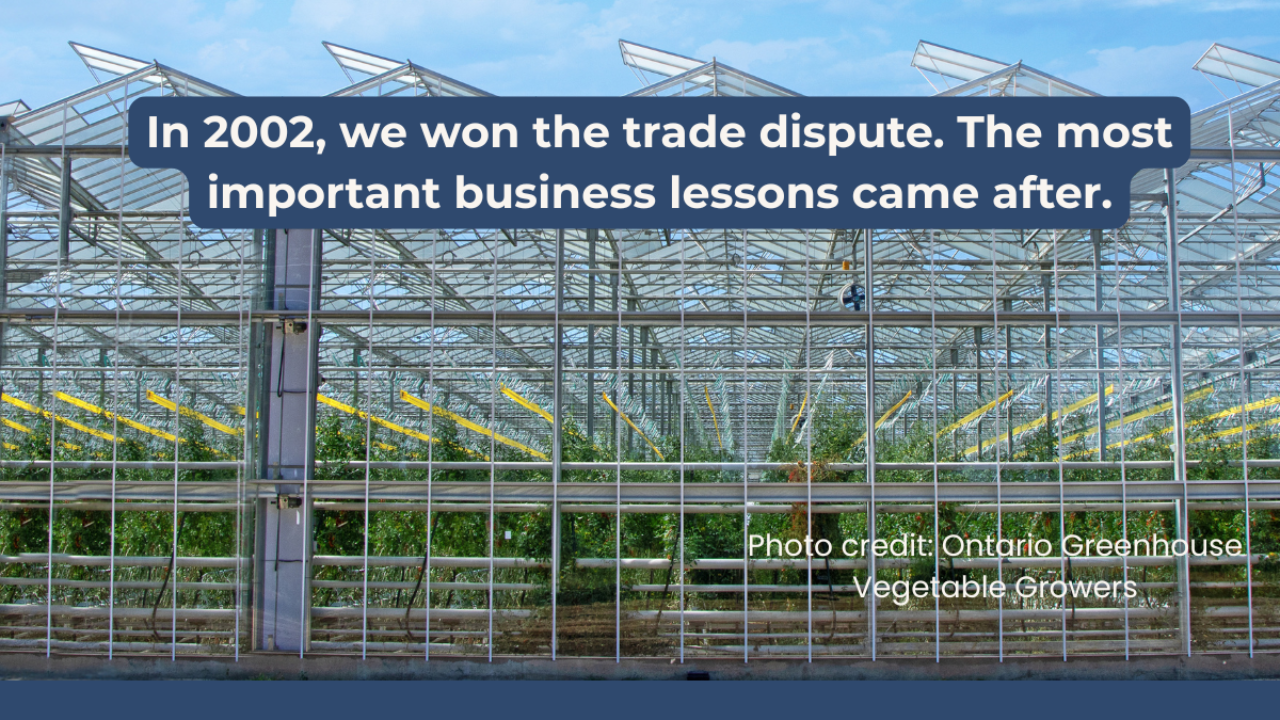
More than 20 years ago, I watched a Canadian industry fight for access to its most important market.
In 2001, U.S. growers launched an anti-dumping case against Canadian greenhouse tomatoes.
When I joined the Board of Directors for Ontario Greenhouse Vegetable Growers, the trade action was already underway.
The 2001-2002 Trade Dispute
The official trade action began in March 2001 and wasn't resolved until April 2002. Almost fourteen months of uncertainty and stress.
Canada ultimately prevailed. The United States International Trade Commission ruled that the Canadian industry was not selling into the US at less than their costs of production and that the US tomato producers had not been materially damaged.
And then something interesting happened.
You might have thought that the Canadian industry would quickly reduce their exposure to the market south of the border.
But that’s not what happened. The industry kept selling an enormous percentage of its product to the United States.
Today, approximately 85% of total Canadian greenhouse vegetable production is sold into the U.S., while, because of the nature of the product, essentially 100% of exports go there.
Concentration risk can come from a series of optimizing decisions
You could look at that and say:
“Why didn't the industry diversify away from the US after what happened?”
That’s a valid question but it ignores the advantages of the status quo.
These are highly perishable products. Geography matters. Transportation time matters. Temperature matters. Logistics matter. Established supply chains matter.
And right next door was the world's largest economy, with enormous demand and attractive economics.
There were very good business reasons to keep selling there. And it was easy to minimize any downsides.
That's what makes concentration risk so interesting.
It isn't necessarily created by bad decisions.
Sometimes it’s created by a long series of perfectly rational ones - stacking one on top of the other.
You optimize around your best customer.
Your strongest market.
Your most efficient supplier.
Your most profitable product.
Your easiest source of capital.
And it works. In the short term.
Until something outside your control changes.
A Case of History Repeating Itself
I'm thinking about that history again as the Canada-U.S. trade relationship enters another period of significant uncertainty. One that is much more widespread than this example and has the potential for much greater impact across the economy.
And I'm seeing the effects play out very differently across the businesses I'm close to.
For some, the current environment is a very big deal and immediate action and adjustments have been called for.
Some have little exposure to the US market but have to deal with the overall economic uncertainty.
Some have a product that is essential to their US customers and cannot easily be replaced. This has given them a longer runway to respond.
Others have actually benefited as Canadians and other supporters have changed where they buy, where they travel and which companies they choose to support.
And I've seen businesses dealing with the consequences of the elimination of the U.S. de minimis exemption.
Same geopolitical environment.
Radically different business consequences.
Which is why I don't think the useful conversation for founders is:
What should we have done differently?
Decisions were made and we have to play the ball where it now lies.
You have the customers you have.
The supply chain you have.
The markets you serve.
The cost structure you've built.
The cash reserves and capital you have available.
The strategic question is what you do from here.
Where are you concentrated - and where has that concentration become a vulnerability?
What has changed - temporarily or structurally?
What happens to revenue, margin and cash if the current situation continues for six months? Twelve? Longer?
Where do you have pricing power?
Which customer or supplier relationships need attention now?
Where would diversification actually improve resilience - and where would it simply add cost and complexity?
What decisions can wait?
And which ones become considerably more expensive if you wait?
Because resilience isn't about trying to predict what Washington or Ottawa will do next.
It's about understanding where your business is exposed, deciding which risks you're willing and able to live with, and building enough strength and optionality to respond as the world changes.
Sometimes the biggest vulnerabilities in a business are the result of the things that, at the time, we optimized most successfully.
Author

Marilyn Crowley
Strategic Advisor and Thought Partner
I help ambitious founders strengthen the strategy, financial and operational architecture, leadership capacity and decision-making foundations needed to build a business that supports their biggest vision.
THE FOUNDER'S NOTEBOOK
Always a story.Always something worth thinking about.
